Working at Freedom Reads often compels us to give a part of ourselves that we may not realize we can afford to give. When the newly formed Freedom Reads Communications Team—Craig Gore, James Davis III, and Autumn Gordon-Chow—recently entered New Jersey prisons together for the first time to open Freedom Libraries, they encountered something profound: familiar faces reflected back at them. In the eyes of incarcerated people at Middlesex Youth Detention Center and South Woods State Prison, they saw themselves, their children, their shared humanity. Here, they share their reflections on what they found.
Returning to Familiar Spaces
For Craig and James, walking back into a correctional facility means confronting their own pasts in the present tense. Craig describes trying to capture his experience at Middlesex Youth Detention Center as being like the hours he spent in his cell wrestling with a cheap, bent-up commissary antenna trying to get the Bounce channel—his reception, his retrospection, blurred from some perspectives and clear in others.
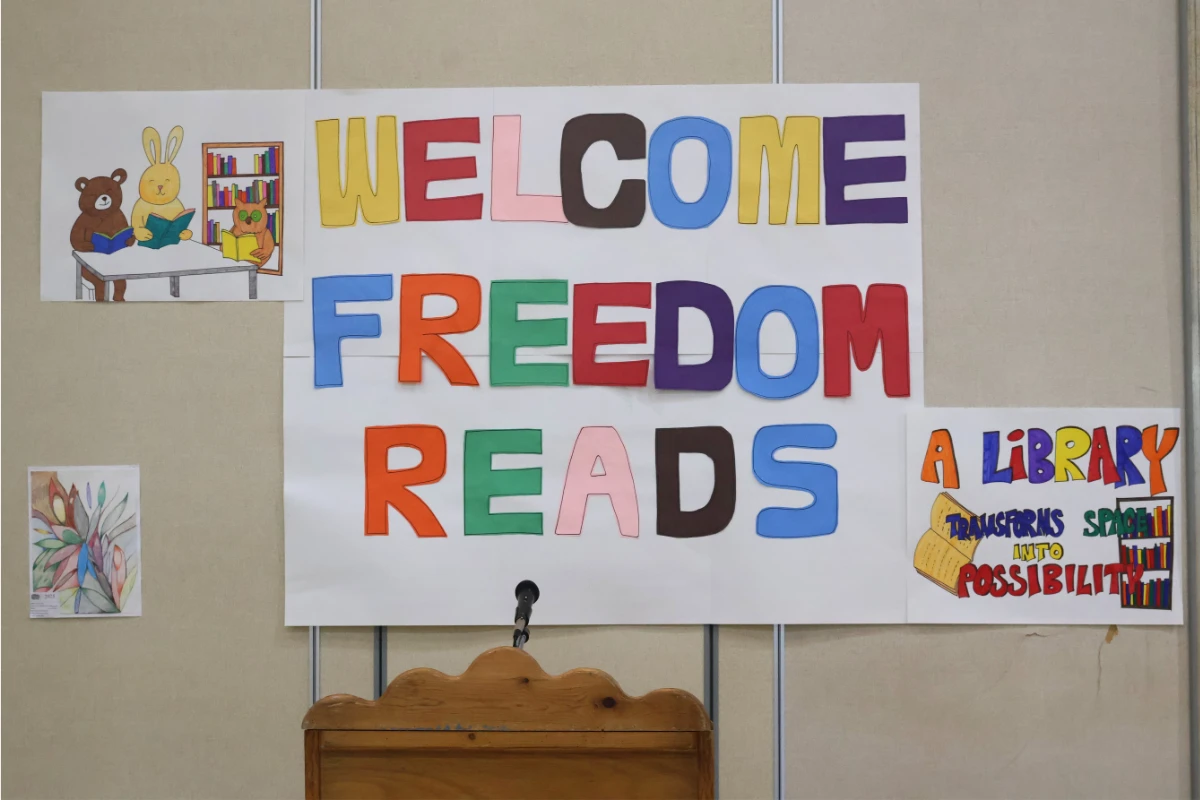
What came into sharp focus was the division in the room. Walking into the gym at Middlesex Youth, Craig saw the huge "WELCOME FREEDOM READS" poster. The gym wall was plastered with art made by the juvenile residents, who sat admiring and cracking on each other's pieces.
"They are where I once was in life," Craig reflects. "I was looking myself in the face. Every face, regardless of race, was my own. I recognized the desire in their eyes; the desire to know, be known, be heard, and to be cared about and cared for."
Craig had been locked up as a juvenile. Standing before the assembly, he felt "a wave of emotion held behind my eyes wanting to break." He thought of the journey that brought him to Middlesex, he thought of his team members, especially wondering what Autumn was thinking and how she was doing, knowing this was her first time in a prison.
For James, who spent 25 years inside before his release in July 2025, the return to South Woods on a cold Wednesday morning brought its own reckoning. "Close my eyes and I could have been walking inside the yellow lines to avoid any interaction with prison staff," he says. Following the rules had been his way to be invisible. But on this day, invisibility wasn't an option—and it wasn't the goal.
"I wanted to be present and highly visible to all the brothers I saw walking the prison grounds in their state-issued clothing," James explains. "I am more than a visitor each time I step back inside a correctional facility. I understand that I am an ambassador of hope and my job is to be present and to interact with as many of our Freedom Library patrons as I can."
First Time Inside: Confronting Uncertainty
For Autumn, entering a prison for the first time brought a different kind of confrontation—one with herself. "I would be lying if I said I wasn't nervous," she admits. "That's what uncertainty does to us."
Walking into Middlesex Youth with her young children at home, Autumn found it impossible not to see her own kids in the faces of these young men. But what surprised her most wasn't an uneasiness about the institutional setting, the security checks, or the constant presence of correctional officers.
"My discomfort was with myself," Autumn says. "I felt an intense hesitation to engage with the youth in the way I so deeply wanted to. Why was I so hesitant? I wanted to connect. I wanted to engage."
Both Craig and James had been conscious of Autumn's experience throughout the day, aware of her hypervisibility as a woman in these spaces and hoping she was finding her footing. After they left the facility, Autumn spoke candidly with Craig and James about her feelings.
"What followed was a conversation I will carry with me for the rest of my life," Autumn shared. "They reminded me that I didn't need the perfect words or the right approach, only the willingness to be present and human."
That conversation transformed her experience. The next day at South Woods, Autumn felt no hesitation. "This experience taught me how to truly show up. I realized that showing up is far simpler than I had imagined. Connection grows when people are willing to meet one another as they are, with open hearts and open minds.”
Building Connections
At Middlesex Youth, the team encountered someone who embodies what it means to show up every day. Alexis Dixon, a social worker with the New Jersey DOC.
Craig was struck watching the young men at Middlesex interact with Alexis. "I could see each young man's countenance light up at their interactions with her," he observes. "They know she really cares about them. Seeing the way that Alexis cared about the residents at Middlesex Youth Detention Center makes me hope the young men have the insight to see it."
Craig and James delivered over 20 unit talks during their visit to South Woods, getting a chance to build with brothers throughout the day. These conversations are where the power of lived experience becomes undeniable.
"Each time we spoke, I saw that same spark when we talked about how Freedom Reads got started with a young brother in seg and then broke down how we had done time," James says. "The connections made between our stories and theirs are too close to deny, and that is what is always evident in the eyes. That undeniable glimmer of hope and positivity may not be present when we arrive. It's always there when we leave, though."
The Paradox of Leaving
"It is not as easy as it should be to leave a prison," James observes. "Who doesn't want to get out of prison as fast as is humanly possible?"
"Building with the people is the highlight of every library opening for me," he explains. "I remember what it was like to see the Freedom Reads team in my housing unit when I was Inside."
This is the paradox at the heart of Freedom Reads' work: showing up means, eventually, leaving. But the team carries forward the knowledge that these connections continue, that they will return, that no one is forgotten.
"We want to help people Inside know that they aren't alone, that they have not been forgotten. And we show up to build connections. That is one reason it is hard to leave. But these connections continue, and when we show up to meet one another as we are, bringing books, joy, and hope, the leaving becomes more tolerable. Knowing we will continue to show up for others pushes us forward."