By
Mobolaji Otuyelu, Creative Assistant, Freedom Reads
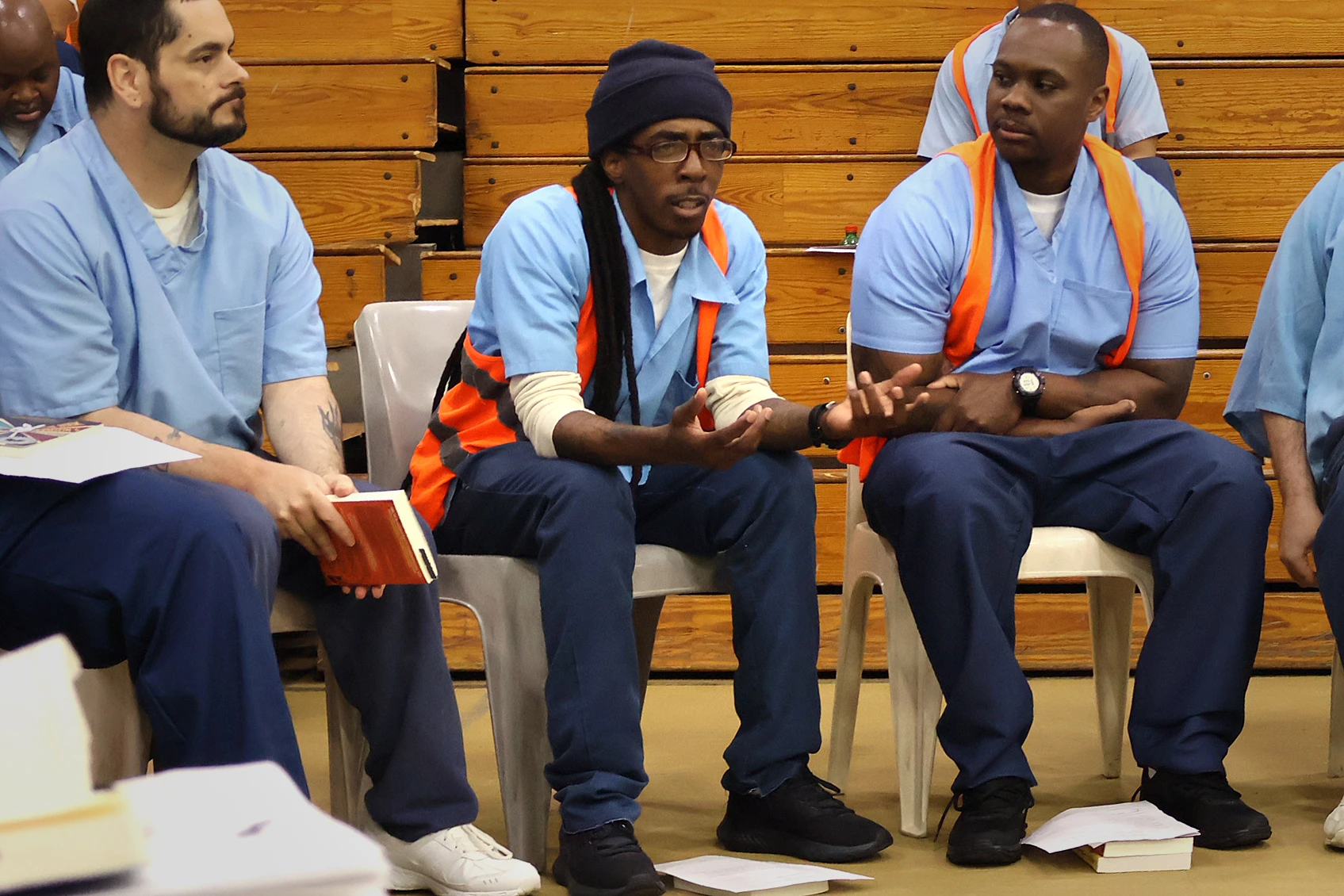
Having grown up in Nigeria, I came to study in America with little to no understanding of the Black experience beyond what I had absorbed from television and popular culture. Those images were partial, flattened, and removed from the textures of daily life. It wasn’t until I encountered Richard Wright’s Black Boy that I began to see a deeper, more unsettling truth about America and the struggles of Black life—a truth that resonates strongly for those experiencing confinement.
By
Dempsey, Resident Creative Writer, Freedom Reads
Dolphins. They were everywhere. Springing and spraying in and out of an undulating tangerine sea set ablaze by a fiery-gold sun. An oceanic dreamscape with splashing dolphins and soaring seabirds doing what they do while the summer sun burns and drips smooth as honey. Such a scene is what a visual artist painted after she visited a prisoner on death row in California and asked him what he thought about from one grey day to the next. He mentioned thinking about a number of things while behind bars. Thinks he should never have committed his crime. Any crime. No time. Though he mostly thought about dolphins and seabirds soaring and splashing in and over the deep blue sea. Perhaps the image represented freedom in its truest form to the prisoner. Freedom in its most elemental state. Freedom in the abstract. Freedom without contract. Freedom that does not detract nor subtract but is pure and simple and intact. Just freedom.
Alexandra Horowitz (L) and Dwayne Betts (R) in conversation at the Brooklyn Pubic Library.
Lori reflects on “Doggerel in the Stacks,” a recent Brooklyn Public Library event with Freedom Reads Founder & CEO Dwayne Betts and dog cognition expert Alexandra Horowitz. In the blog, Lori explores the surprising links between prisons, poetry, and life with dogs — and what they can teach us about how we see the world.
By
Autumn Gordon-Chow, Craig Gore, and James Davis III
A welcome sign made by incarcerated youth at Middlesex County Juvenile Detention Center, New Jersey.
Working at Freedom Reads often compels us to give a part of ourselves that we may not realize we can afford to give. When the newly formed Freedom Reads Communications Team—Craig Gore, James Davis III, and Autumn Gordon-Chow—recently entered New Jersey prisons together for the first time to open Freedom Libraries, they encountered something profound: familiar faces reflected back at them. In the eyes of incarcerated people at Middlesex Youth Detention Center and South Woods State Prison, they saw themselves, their children, their shared humanity. Here, they share their reflections on what they found.
Freedom Reads' Library Coordination Manager, David Perez, at the 2025 Inside Literary Prize Award Ceremony at the New York Public Library.
If you’ve ever wondered how Freedom Reads libraries seem to appear across the country with care, precision, and soul, chances are David is somewhere in the middle of it all.
As Library Coordination Manager, David’s days resist routine. One morning might begin in conversation with a department of corrections, shift into planning an Inside event with an author, and close with a Zoom book discussion alongside readers on the Inside. Each day unfolds differently, and that constant motion is part of what makes the work feel special.
By
Reginald Dwayne Betts, Founder & CEO, Freedom Reads
Freedom Reads library production site at the home office in Hamden, CT.(Photo: Justin Marantz)
This November, on his 50th birthday, J. Davis walked into a Maryland prison to open Freedom Libraries. He’d been out of prison fewer days than some of us have spent in the hole. But sometimes, to return is the ultimate act of care.
This year we opened nearly 200 Freedom Libraries across 17 prisons in 7 states. Since this journey began, we’ve now opened more than 600 handcrafted bookcases made of maple, walnut, oak, and cherry. That’s 300,000 brand-new paperbacks. And nearly every one of those libraries was built by the hands of Jimmy or Mike. We knew where they would land because Tyler and David made sure Departments of Corrections said yes, and Kevin made sure that when a prison said yes, libraries were waiting.
By
Reginald Dwayne Betts, Founder & CEO, Freedom Reads
The first time I went to Puerto Rico, my oldest son, Micah—who just turned eighteen this month—was still in grade school. His little brother Miles wasn’t yet a year old. It was 2012 and I would have never imagined Freedom Reads, an organization that believes literature is a conduit to the kind of joy I felt watching my oldest play with his little brother walking distance from one of the most beautiful beaches I’ve ever traversed. The clarity of the water, the way the waves half-washed all the years of prison I’d known. I was there for a conference, and prison was somehow both the furthest thing from my mind and the closest thing on it. Because that’s how it’s been since March 4th, 2005: no matter the city, no matter the coast, every place I’ve been has circled back to prison, or to the long shadow of my relationship with it.
By
Reginald Dwayne Betts, Founder & CEO, Freedom Reads
This month the team opened Libraries in Missouri and I read from Doggerel in the women’s prison. Our newest team member, James Davis III, took his first trip in 30 years, to return to a prison after being locked up in one for almost that long. I left Missouri so early in the morning that even the earliest dragon birds were still asleep. The night was still run by raccoons and opossums, the creatures that I've learned to love while riding on my 3am treks. I was at the airport, and it felt like I had walked into a scene from Percy Jackson, because everything was open. Starbucks was open, another coffee shop was open, and a bar was open. That's where I had breakfast. I walked to the bar starving in a way that only a man who has just left a prison knows and I wanted potatoes. “These mornings are familiar,” I say to no one, thinking of all my recent mornings in airports. “I once had a rule, I only drink when I’m awake,” the person beside me said. When I mentioned my poem, Whiskey for Breakfast, the bartender, this dark-haired woman, who stared just about as far as my mom, said, “Now you must read for your breakfast.” She didn't expect me to, but I sang: my liver, awash in all but the dregs of a charred out cask….
Just 100 days since leaving prison after 25 years and 6 months, and I was going back Inside. Working for Freedom Reads means going back to prison. Freedom Reads went to Missouri to open 35 Freedom Libraries in two facilities and they would be the first two in the state to have the beautifully handcrafted wooden libraries. Women’s Eastern Reception, Diagnostic and Correctional Center (WERDCC) received 15 cherry wood libraries built in the New Orleans office; 20 libraries built in the home office in Connecticut went to FRDC (Fulton Reception and Diagnostic Center). It was my first trip to open Freedom Libraries with the team and it was intense.
By
Mobolaji Otuyelu, Creative Assistant, Freedom Reads
I first encountered Albert Camus’ L’Étranger(The Stranger) in a college philosophy class. It was the first time I came across the concept of the Absurd. As a student navigating a country far removed from the one I had always known, the book gave me language to make sense of a world that felt unfamiliar and strange. I realized this new world could become a place where ambiguity was a refuge, where life’s contradictions could exist without neat explanations. This initial encounter left an impression I have carried with me ever since.
By
Mobolaji Otuyelu, Creative Assistant, Freedom Reads
A glimpse of the creativity of Freedom Reads Assistant Controller, Teryn Jasmin — masterpieces from a recent paint-and-sip party.
At Freedom Reads, every role is essential to bringing books and hope into prisons. Teryn Jasmin, our Assistant Controller, exemplifies the vital financial work that keeps our organization running smoothly and ensures that our mission can thrive.
By
Ray V. Boyd, Program Manager at Yale University Law and Racial Justice Center
Freedom Reads Founder & CEO, Reginald Dwayne Betts with Ray V. Boyd at a past event.
Going into prison as a confused and ill-informed young boy and staying for three decades, afforded me many opportunities to think about freedom. At 19yrs young I was serving a 50 year sentence and freedom in my mind was abstract. It was a word that I’ve been hearing for as long as I can remember hearing words and making out how to use them. I could never conceptualize what freedom was. I had nothing I could point to and say, “Look, freedom!” Prior to going to prison the conception of freedom in my mind was imaginary, not realistic.