I’ve always struggled with the beginnings of things, for me it makes the most sense to meander my way into things. In a way, I meandered my way into prison. I took the crash course: petty crime to carjacking before the midterms of my junior year. I get locked up in December and I might as well have gotten locked up in January. End of the year, beginning of the year – you get to imagine where you’ve been and what you’ve become.
In The Theory of Moral Sentiments, Adam Smith writes that “man naturally desires, not only to be loved, but to be lovely; or to be that thing which is the natural and proper object of love.” After he sentenced me, my judge told me that I could get something out of prison if I wanted. I’ve never appreciated what he said as much as I’ve come to as I get older. Candidly, Freedom Reads has been the opportunity for me to ask myself what it means to be lovely. What it means to watch all of us in this organization return to places that the entire world knows to be haunted and too often imagines is bereft. We go, and imagine that in going, it is because we know to ignore our kin inspires dread. And as Smith says, we dread “not only to be hated, but to be hateful.” And to ignore someone in need is to be hateful. At least I imagine that’s the case, when I think of all the people who have not ignored me in my moments of need, fleeting or long seasons; I’ve always had strangers cosplaying as paladins, or paladins cosplaying as strangers. Or just angels humble enough to need not announce themselves.
In 2026, Freedom Reads is going to keep at it. Right now, I’m parked at the Union Station in New Haven. This is where travelers often arrive, on trains from places as close as New York as far as Virginia, where my sons’ grandmother would arrive. It’s one of those things. If you’re lucky, people come to see you to say that you are both visible and loved.
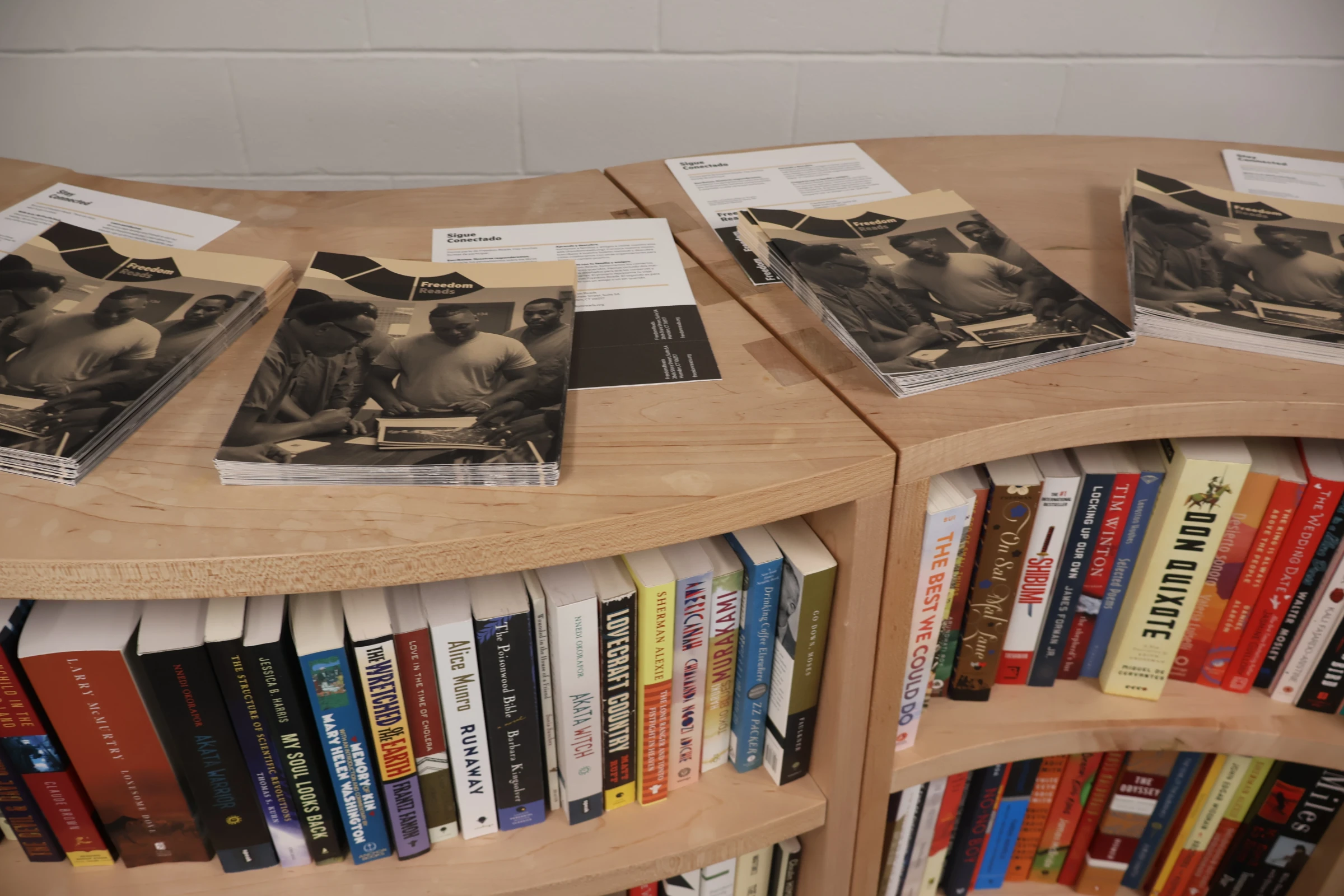
Freedom Reads returns to prisons with Freedom Libraries, with books as pathways to possibility. We show up, though, for reasons that have nothing to do with what we are or what we might be; we show up because there are so many Inside who are lovely, and deserve to be seen as such, and not the objects of scorn and suffering.
I know this because I hear from men like Rafael Morato. While working on a sanitation crew at Rikers Island, Rafael spotted a young woman struggling with a library on a dolly. Where others might have seen a delivery, Rafael saw the "curves" of the fine bookcases with the eyes of a man whose grandfather’s grandfather was a woodworker. He carried with him the history of a grandfather who worked under the Dominican dictator Rafael L. Trujillo, eventually bringing his wife and fourteen children to this country because his skill with woodwork and housebuilding was his ticket to a different life.
Rafael, a combat veteran and welder who is "nice with it," ran over to assist with the dolly not just as a gentleman, but as the heir to that lineage. He wrote to tell me that escaping into books is how he keeps his sanity, but his letter was also an offer: he wants to come out of retirement upon his release just to weld for us. He wrote, "Thank you for not forgetting the forgotten like a lot of society has." It is for Rafael, and the thousands like him who recognize the beauty in the craft before they even open the books, that we do this work. We return to the haunted places because even there, women and men are waiting to admire the curves of a life built with care.
Join Us: Our mission is as clear as it is vast: a Freedom Library in every cellblock in America. We believe that every person deserves the opportunity to be seen, to read, and to imagine a different beginning. Support Freedom Reads today and help us turn these pathways to possible into a reality for everyone still waiting Inside.