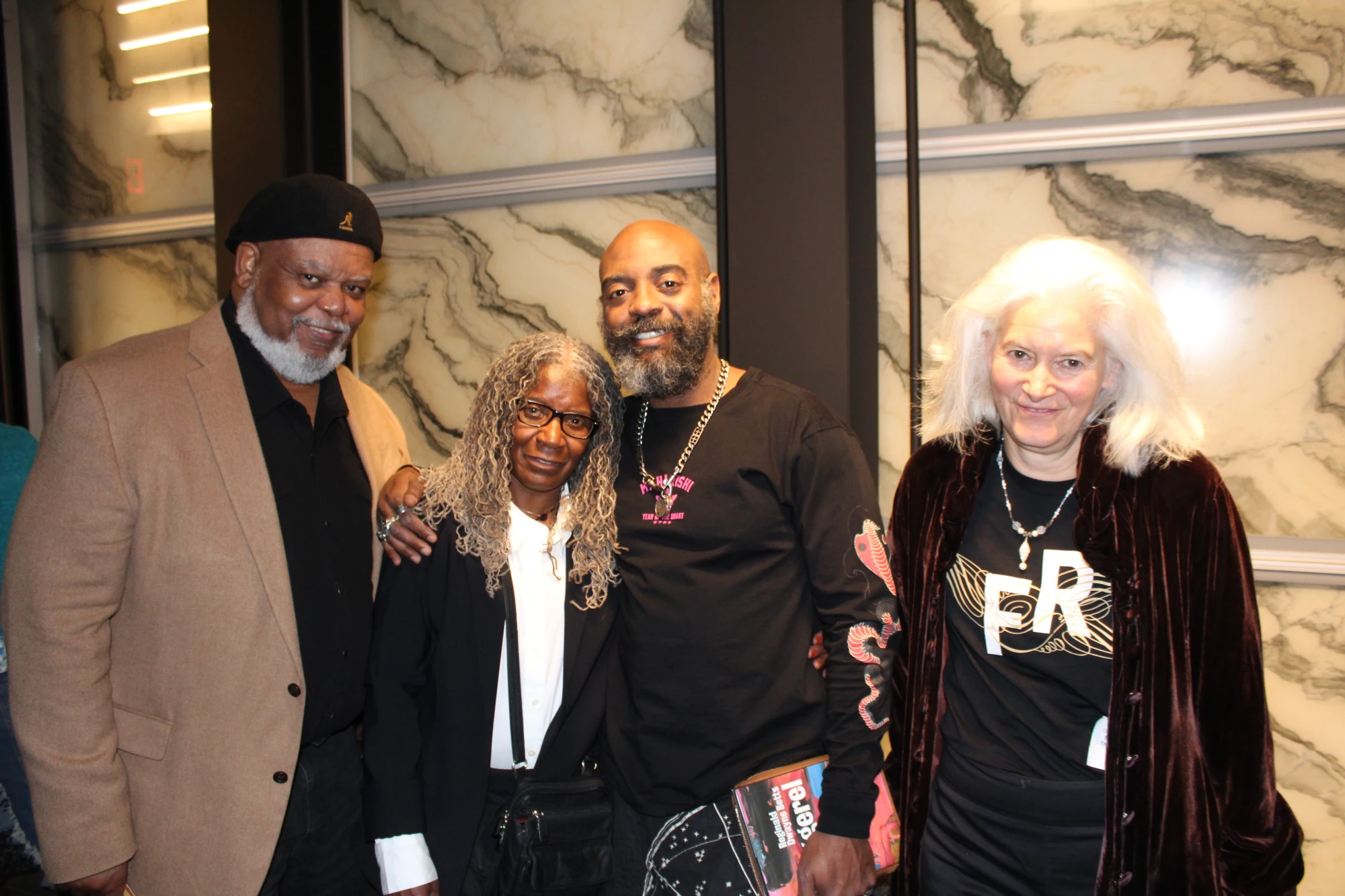
This is what I know about sadness: it frightens people. One day, you wake up and your world feels filled with the second O of sorrow. This is what my friend Sean Thomas Dougherty might say. He is a white man, who works the night shift and writes beautiful poems about being alive in this cruel world. He once wrote a poem about Biggie Smalls that made me believe he was from my neighborhood. And no matter how sad his songs have been, they make me believe there is a world just past suffering. And when I read him, even when he is suffering between those lines, I imagine the writing has given him some of that place that is more heaven than purgatory.
Continue ReadingTagged with Founder's Takes
I remember my first holiday meal in prison. I’d just turned eighteen-years-old a few weeks before, my second of eight birthdays Inside. I was at Southampton Correctional Center in Capron, Virginia. There are still a lot of folks I remember who would have been in the chow hall that day, some I still talk to. Fats, Star, Divine, Smoke. That dinner, they served Cornish hens. I didn’t know what that was then but knew it was delicious. Later found out these hens are juvenile chickens particularly tender for eating.
Continue ReadingWithout me knowing it, prison became the center of my life. I have thought about what a prison cell does to a man for more consecutive days than I have contemplated what it means to be a good man, let alone a father. Sometimes, I imagine that prison has become more than a metaphor, but the literal antecedent to every move I make. It’s a lonely place.
Continue ReadingI’ve learned that some of us, with these two ears of ours, though parallel and balanced, still hear like owls – with a particular precision. Owls have ears that almost function as longitude and latitude. At forty miles per hour and over three feet of freshly fallen snow, an owl can swoop down and locate the heart pulse of a mole twelve inches buried in white. I am humbled by that necessary focus. And though my brain is scattered as some memories might be, my receptors are finely tuned to decipher, and sometimes only this, complicated text into the reasons I am not loved.
Continue ReadingThis is what David Foster Wallace says – the only choice we get is what we worship. And for many years, I have worshipped a Janus-Faced G-d. The G-d of Silence and the G-d of Discontent. I've probably worshipped other g-ds as well, maybe we all have. But these days I think a lot about silence and discontent. It's wild, too, in a way, as someone recently said to me, Dwayne, I'm surprised you complain about anything, look at how charmed your life is.
Continue ReadingFor years I’ve had a gripe with the ACLU. During the winter of 1998, the same winter that I became a poet, my friend Markeese Turnage and I wrote a letter to the ACLU asking for legal help. Keese had been sentenced to more than sixty years in prison. He didn’t have a rape, murder, or robbery conviction. Instead, he’d wrangled an officer’s gun from him and attempted to turn it on himself. The gun never went off. No one was hurt. He was 17 years old. For Christmas that year, the ACLU sent us a form letter back. And today, Keese is still incarcerated. I’d used his story to get myself admitted to Yale Law School; I’d used his story to get him a lawyer once I was a graduate of the same. And still, years later, he is inside, as loss after loss accumulates.
Continue ReadingIt was all a dream. Or not a dream, but a fantasy, this belief that people would get behind the idea of the Freedom Library. The Freedom Library, which, at its root, is simply the notion that beauty and literature matter. That nature matters. That incarceration should not deprive people of these things. To put this all in another way, I’ll say that I was thinking like they thought with the Field of Dreams, that is: If you build it, they will come.
Continue Reading
The paradox of incarceration is that if you’ve been inside, you desperately want to believe that the time you spent in those cells matters. You understand that you did more than weep in those cells, more than endure suffering. You know that you’ve nurtured anger and then figured out how to let it go, if you’re lucky. You know that you’ve discovered ways to forgive yourself, often long before the people in the world knew your name. You know you spent more hours than you know figuring out how to apologize, and then even more hours afraid to do it. And sadly, you know the world holds that work in slight regard.
Continue ReadingYesterday I learned something. One of our team members, a brother who has been with us for nearly a year now, served time in prison. I never knew. I thought of him in the same way that I’ve thought of Claire in the past, or Allie now, or Gabby. I thought of Mike in the same way I’ve thought of Tyler or David or any of the dozens of people we work with, which is to say, I thought of him as one of the bedrocks of the organization. See, Mike is one of the folks that touches nearly every Freedom Library that we build, working with his hands to transform remnants of trees into hope and possibility. And yesterday, as we celebrated a significant grant given to us by the Connecticut Health and Educational Facilities Authority (CHEFA), he talked about the time he’d served in prison and what it meant to come home to this work.
Continue Reading
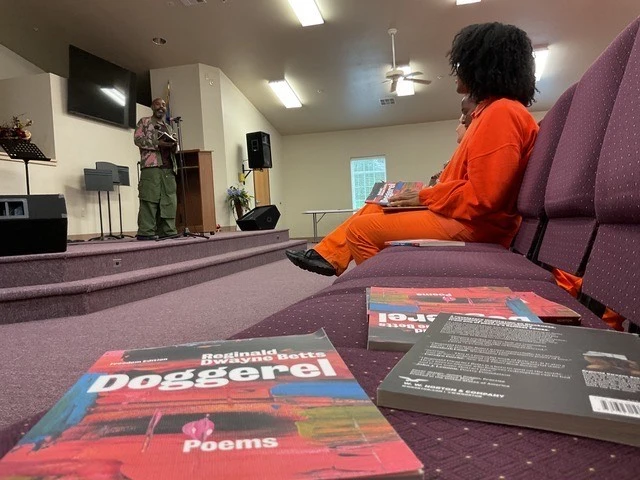
This is what they cannot tell you to expect: that you’ll return. No, that’s not true. They predict that you will return in handcuffs. Never as it happened on March 4, 2024. That morning, I returned as a poet who would perform for them as if the men inside were a Broadway audience; I returned as someone who’d served time with them, as a lawyer who’d been trained in the cells they knew too well.
Continue Reading
There are more than 800 pillars, large corten steel monuments that seemingly hang from the sky at the National Memorial for Peace and Justice. The monuments are memorials. The Oxford English Dictionary says the etymology, a fancy way to say word origin, of memorial is the Latin memoriālis, an adjective for records or the French memorial, an adjective for commemorative, remembered. In this country, there are more things that we would rather forget than remember. The National Memorial for Peace and Justice is about remembering. And so, each pillar has the name of a county in America where a lynching has occurred, each has the names, when known, of people who were lynched in this country.
Continue Reading
“A yo Shy, you know this ain’t your fault right,” my man calls to tell me the day after he’s been denied parole again. I’m his lawyer. But also his friend. We've called the same prison cells home. And so he wants me to know that he doesn’t blame me for this. He says this failure ain’t on me, it’s on the system. I’ve heard it before. From other friends. Always consoling me as if I’m still going to be serving time instead of them.
Continue Reading